
Explorer’s Guide to Impact Craters
Haughton Crater Tour
- Getting to Ries Crater
- Virtual Tour of Ries Crater
- Nördlingen
- Ries Tour – Stop 1
- Ries Tour – Stop 2
- Ries Tour – Stop 3
- Ries Tour – Stop 4
- Ries Tour – Stop 5
- Ries Tour – Stop 6
- Ries Tour – Stop 7
- Ries Tour – Stop 8
- Ries Tour – Stop 9
- Ries Tour – Stop 10
- Ries Tour – Stop 11
- Ries Tour – Stop 12
- Ries Tour – Stop 13
- Ries Tour – Stop 14
- Ries Tour – Stop 15
- Ries Tour – Stop 16
- Ries Tour – Stop 17
- Ries Tour – Stop 18
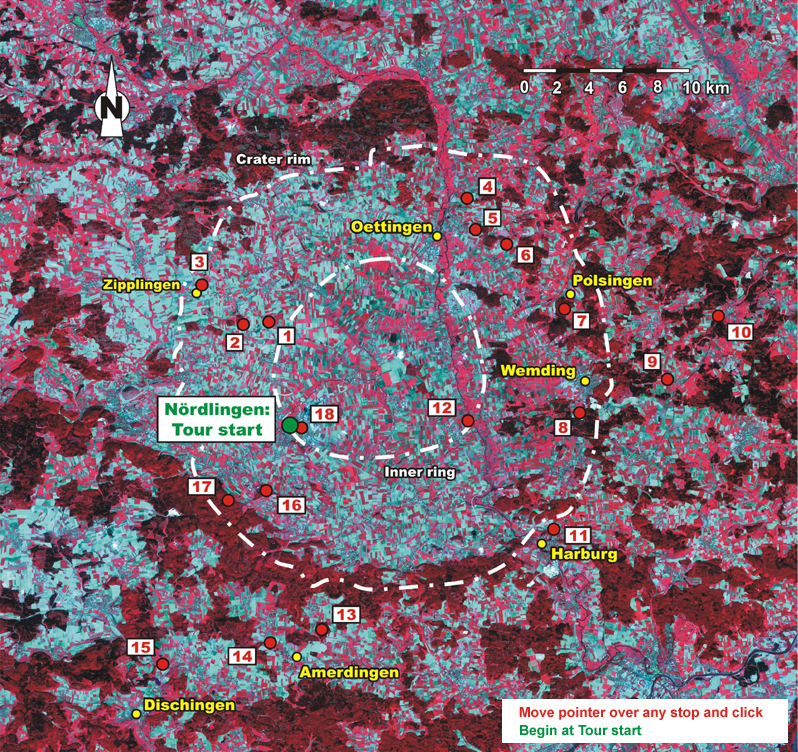
Stop 5 at Ries

Post-impact crater-lake sediments at Hainsfarth
Photo: G. Osinski, University of Western Ontario
Location: Megablock zone of the impact structure
Scale: Height of the cliff is 4.5 meters
As we drive out of Hainsfarth towards the southeast, we follow the signs to the “Sportzplatz”, a football (soccer) field. Here, we can see a series of limestones that were deposited in a lake that formed soon after the formation of the Ries structure. Lake sediments completely fill the central basin at the Ries and are present all around the inner flanks of the crater rim, which suggests that a very large lake completely filled the crater soon after it formed.

Algal bioherm signatures in the crater-lake sediments
Photo: G. Osinski, University of Western Ontario
Location: Megablock zone of the impact structure
Scale: Length of the pen is 12 centimeters
If we take a closer look, we can see abundant spherical and cone-shaped algal bioherms. These are structures formed by blue-green algae that grew in the crater-lake. They are not strictly fossils, but rather the structures left behind after the algae died. One of the surprising things about meteorite impact craters is while they may be environmentally devastating after their formation, these craters become sites for life to thrive again. In fact, there is evidence that suggests impact craters actually form oases where many plants and animals prefer to live in compared to the surrounding terrain.