
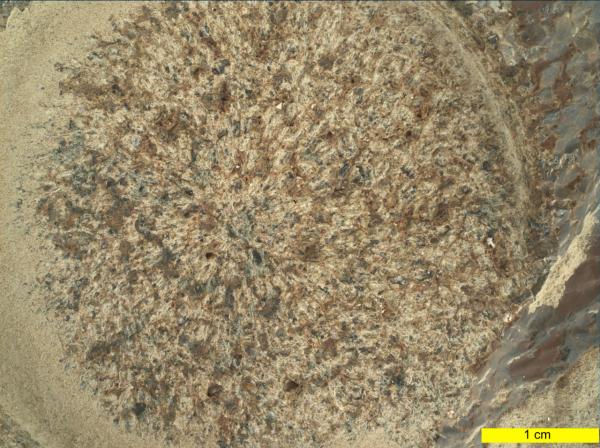
Scientists are getting a closer look of potential organic signatures in Martian rocks and may have found evidence of key building blocks of life preserved within two potentially habitable paleo-depositional settings in Mars’ Jezero crater. These organics, a class of carbon-based molecules, could have been left by ancient microbial life – though there are many geological sources of organics on Mars that could explain their presence, as well.
“This is also one of the first reports of potential organics in Jezero crater,” said Ashley E. Murphy, a research scientist at the Planetary Science Institute and co-author of “Diverse organic-mineral associations in Jezero crater, Mars that appears in Nature. Sunanda Sharma of the Jet Propulsion Laboratory and Ryan D. Roppel of the University of Pittsburgh are co-lead authors.
“The SHERLOC instrument on the Perseverance rover’s robotic arm allows for the spatial resolution needed to observe important mineral-organic relationships to evaluate potential biosignatures,” Murphy said.
SHERLOC, the Scanning Habitable Environments with Raman & Luminescence for Organics & Chemicals instrument, is mounted on the robotic arm of NASA’s Perseverance Rover. SHERLOC uses cameras, spectrometers, and a laser to search for organics and minerals that have been altered by watery environments and may be signs of past microbial life.
The paper reports the detection of Raman and fluorescence spectra consistent with multiple species of aromatic organic molecules in the Máaz and Séítah formations within the Crater Floor sequences of Jezero crater. Specific fluorescence-mineral associations consistent with multiple classes of organic molecules occurring in different spatial patterns within these compositionally distinct formations, potentially indicating different fates of carbon across environments.
“The big takeaway here is, with SHERLOC’s grain-by-grain resolution we can finally observe variation in organic preservation within the rocks on Mars,” Murphy said.
“The fluorescence features detected with SHERLOC are consistent with types of organics – single-ring aromatics and polycyclic aromatic hydrocarbons – previously observed in Gale crater and Martian meteorites. The detection of diverse organics in two ancient lakes (Gale and Jezero craters) on Mars is important for understanding the extent and diversity of Martian surface processes and how this relates to habitability and potential life detection,” Murphy said.
The fluorescence and Raman signals observed in the Jezero crater floor are consistent with organic molecules, which are molecules that have carbon and are the building blocks of life as we know it. These potential organics are found in multiple generations of minerals. “This finding may indicate that Mars once had diverse surface processes and relatively complex organic geochemistry, which on Earth, such mineralogy is associated with habitable environments capable of preserving signs of ancient life,” Murphy said.
“Not all organics are biological in origin. Observing spatial relationships between minerals and organics is necessary when evaluating organic origins and potential biosignatures. Everything we know of life on Earth is limited to what is preserved in the rock-mineral record. On Earth, biosignatures are found in certain minerals and some minerals are better at preserving organics than others,” Murphy said. “Mars may have had a similar early geologic history to Earth so we use our knowledge of life as we know it on Earth for where to look for potential evidence of past life on Mars. Mapping organics allows for a better understanding of if the Martian carbon cycle is similar to or different from Earth, and the potential of Mars to host life.”
Murphy’s work on SHERLOC Instrument Mars 2020 was funded by JPL Subcontract No. 1641753 to PSI.

A close-up view of an engineering model of SHERLOC, one the instruments aboard NASA’s Perseverance Mars rover. Located on the end of the rover’s robotic arm, this instrument features an auto-focusing camera (pictured) that shoots black-and-white images used by SHERLOC’s color camera, called WATSON (Wide Angle Topographic Sensor for Operations and eNgineering), to zero in on rock textures. SHERLOC also has a laser, which aims for the dead center of rock surfaces depicted in WATSON’s images. Credit: NASA/JPL-Caltech.
Media Contact
Alan Fischer
Public Information Officer
520-382-0411
[email protected]
Science Contact
Ashley E. Murphy
Research Scientist
[email protected]