
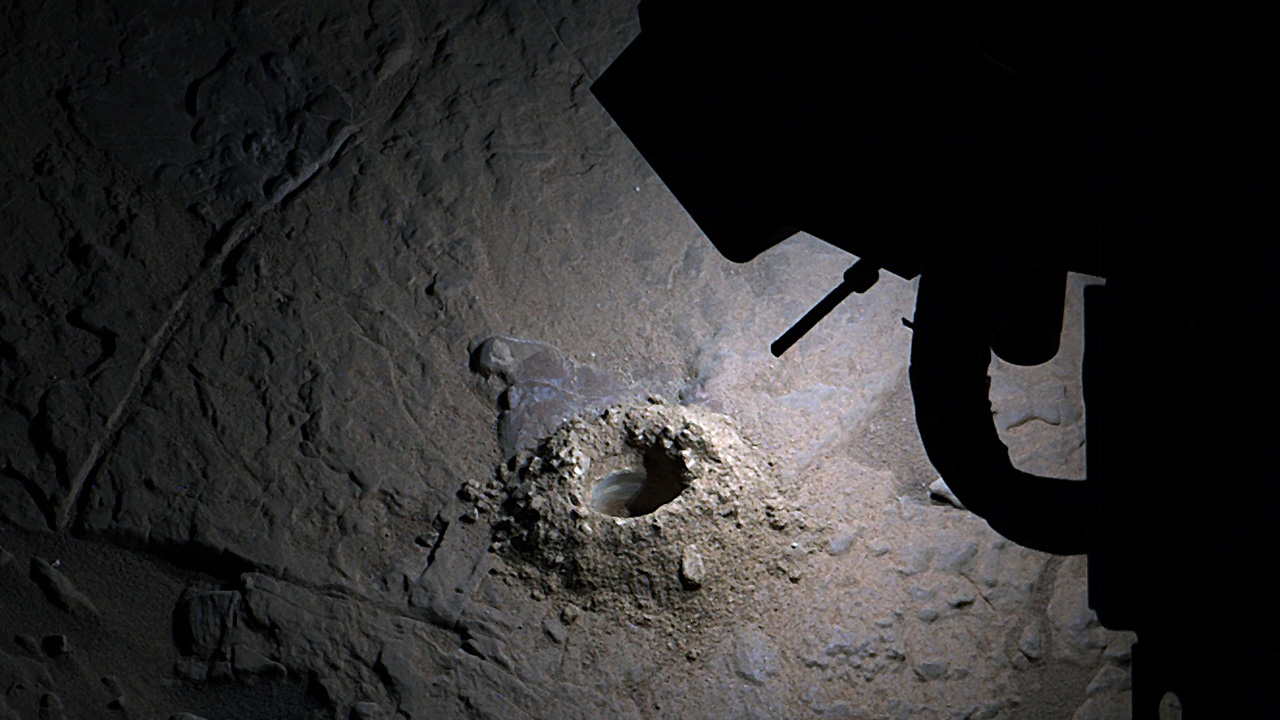
NASA’s Curiosity Mars rover used LED lights to create this rare nighttime view of the Red Planet’s surface on Dec. 6, 2025. The LED lights are part of the Mars Hand Lens Imager, or MAHLI, a camera on the end of Curiosity’s robotic arm.
The MAHLI instrument is led by Planetary Science Institute Senior Scientist R. Aileen Yingst.
The image was captured by the Mast Camera, or Mastcam, on the rover’s mast, or “head.”
On occasion, scientists have used MAHLI’s LED lights to illuminate areas deep in shadow during the day, such as the insides of drill holes and the inlet tubes leading to instruments in the rover’s belly.
Much earlier in the mission, the Curiosity team used these LEDs at night to look for layering or other features in drill hole walls that would help them understand a rock’s composition. Since the mission changed its drilling method, the drill holes have come out too rough and dusty to see any such details.
After drilling a rock target nicknamed “Nevado Sajama” on Nov. 13, 2025 (Sol 4,718), the team noticed the drill hole walls were smooth enough to try looking for layers and decided to try illuminating the drill hole at night.
“In the image, you’ll see layering and structure in the hole, which is what we were hoping for,” Yingst said. “Layers in geology usually indicate a change in the environment or a change in the process by which materials are being deposited.”
This drill hole was made during Curiosity’s exploration of a region full of geologic formations called boxwork, which crisscross the surface for miles and look like giant spiderwebs when viewed from space.
Nevado Sajama is in the Boxworks where a pattern of ridges likely formed when groundwater moved through cracks and fissures and deposited minerals it was carrying in solution, which then hardened.
“That means any layers or other features we see in the drill hole could have been cut by these cracks,” Yingst said. “We might also see evidence of other deposits from groundwater.”
Curiosity was built by NASA’s Jet Propulsion Laboratory, which is managed by Caltech in Pasadena, California. JPL leads the mission on behalf of NASA’s Science Mission Directorate in Washington as part of NASA’s Mars Exploration Program portfolio. Malin Space Science Systems in San Diego built and operates both Mastcam and MAHLI.